
Aqua Locks vs. the Competition
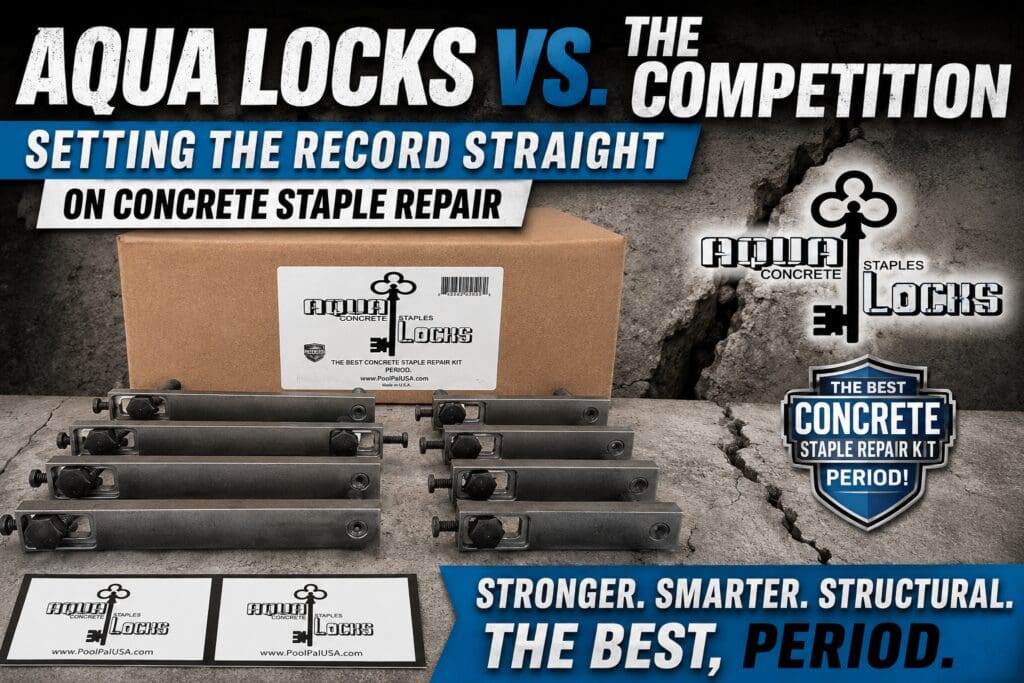
Setting the Record Straight on Concrete Staple Repair
Structural cracks in concrete pool shells don’t fix themselves, and they don’t forgive a weak repair. The shell has already moved once, soil shift, hydrostatic pressure, freeze/thaw, an engineering shortfall, and if the repair doesn’t hold the crack closed, it comes back.
That’s the whole argument for a staple-based structural repair over epoxy alone. Where the industry gets murky is in the marketing (specifically, claims by other “Torque Style” staple kits, claiming engineering when none is none listed). Aqua Locks is the BEST kit on the market. Here’s what the actual product is, and where the common claims don’t hold up against it.
What Aqua Locks Actually Is
The Aqua Locks Concrete Staple Repair Kit is a patented staple system built from 1018 cold rolled steel for the staple body, with a threaded pin and rod made of B7 grade steel and a tensioning bolt, also B7 grade. The threading isn’t decorative, it’s specific so the pin can properly grip both the concrete and the 2-part epoxy it’s set into – per structural engineering requirements for that kind of fastening.
The use of a threaded pin over other brands, using the “torqued” staple rod and bolt rather than a threaded pin means that the Aqua Lock Staple does not push itself back out as it cures like other “Torque Style” brands.
Addressing the Claims
“Knockoff staples lack a torque system and can’t apply measurable load” / “No Controlled Compression” /
Projection means deflecting your own faults onto someone else, this is no different. Some “Torque Style” staples make claims about engineering and PSI of torque that simply are ludicrous at a cursory glance. These staples apply post-tension force by means of angular tension, which, by definition, has no defined PSI. If you rotate a camber at 15 degrees, you will have a completely different tension at 30 degrees. The tension-force will be indirect tension going on an angle. So, if you were to apply a 22 PSI torque force on an offset camber, the amount of actual tension is determined by the degree of angle. Therefore, a camber system is a GIMMICK.
The Aqua Locks Staple uses linear compression. Therefore, if you apply 22lbs of tension on the staple, you get 22lbs of force in a straight line perpendicular to the crack. Linear compression, by engineering standards, is the best and truest method.
NOTE: the pins are only 3/8″
“Corrosion and bleed-out are extremely common with knockoff products” / “Bulky, Unrefined Design”
Some “Torque Style” staples claim that other staples are made of inferior materials and are subject to corrosion and bleed-out. What they DON’T tell you anywhere in their ramblings, is that the staples they are referring to are made of the same exact type and grade metal. The only difference in the metals between the Aqua Locks and “Torque Style” is that Aqua Locks are twice as thick. They even went as far as referring to Aqua Locks staple as being “too bulky”.
I do not know about you, but I have no problem with a heavy-duty, bulky staple that I am depending on to prevent future cracks!
“No Engineered Spacing or Pattern”
“Torque Style” staples competitors make claims that other brands of staples do not have defined, engineered spacing or patterns. Aqua Locks recommends a maximum of 12” spacing. However, we do not discourage someone from using their judgment to decrease the spacing of the staples.
The Real Comparison
When you look at what’s actually in the box rather than the category-level claims:
- Fastening method: Aqua Locks uses a threaded rod and tensioning bolt (B7 grade steel), not a passive strap.
- Sizing: Multiple staple lengths (4″–12″) matched to crack size, not a one-size-fits-all format.
- Placement control: Templates included in every kit.
- Materials: 1018 cold rolled steel body with B7 grade threaded hardware, set in 2-part epoxy for encapsulation.
- Patent status: Aqua Locks is a patented system, not a generic strap sold under a private label.
- If you really have questions about the engineering differenes between “Torque Style” staples and Aqua Locks staples, ask an engineer the difference between linear compression and angular compression. We know you will come to the same conclusion, Aqua Locks are better.
The “Torque Style” framing that shows up in some competitor marketing describes a category, not a specific tested product. Before choosing a structural repair system, it’s worth asking any brand for their actual material specs, installation method, and any independent testing behind their compression or load claims, rather than taking lazy and category-wide marketing claims at face value in either direction.
One Claim Worth a Closer Look
- Some competitor marketing describes their staple as “the ONLY controlled post-tension staple option for structural crack repair.” That’s not a vague marketing line, it’s a specific, checkable claim, and it’s worth checking.
- Aqua Locks installs with a threaded rod and a tensioning bolt (B7 grade steel), seated and tightened against the concrete and epoxy. A tensioning bolt is, by definition, a mechanism for applying and controlling tension. Whatever the merits of one system over another, “only” is a hard word to defend once a second torqued, tensioned staple system exists on the market, and it does.
- It’s also fair to ask what’s actually behind the numbers competitors lead with. A figure like “up to 5,000 lbs of compression” is a strong claim to build a comparison around, but marketing copy doesn’t say where that number comes from, no cited lab report, no third-party test standard, no engineer of record referenced. That’s a reasonable thing to ask for before treating it as an industry benchmark: has that figure been independently verified, and under what test conditions? The same standard should apply to any brand making a compression claim. When using angular compression as “Torque Style” staples do, there is NO consistent number of pounds exerted, because every angle is a change in pounds of compression.
If you’re weighing staple systems for a structural crack repair, look past the “knockoff” label and compare the actual steel grade, fastening method, and what’s included in the box. That’s the comparison that actually predicts how the repair holds up.
Check out our Aqua Locks!
“The Best Concrete Staple Repair Kit PERIOD!”